


Description
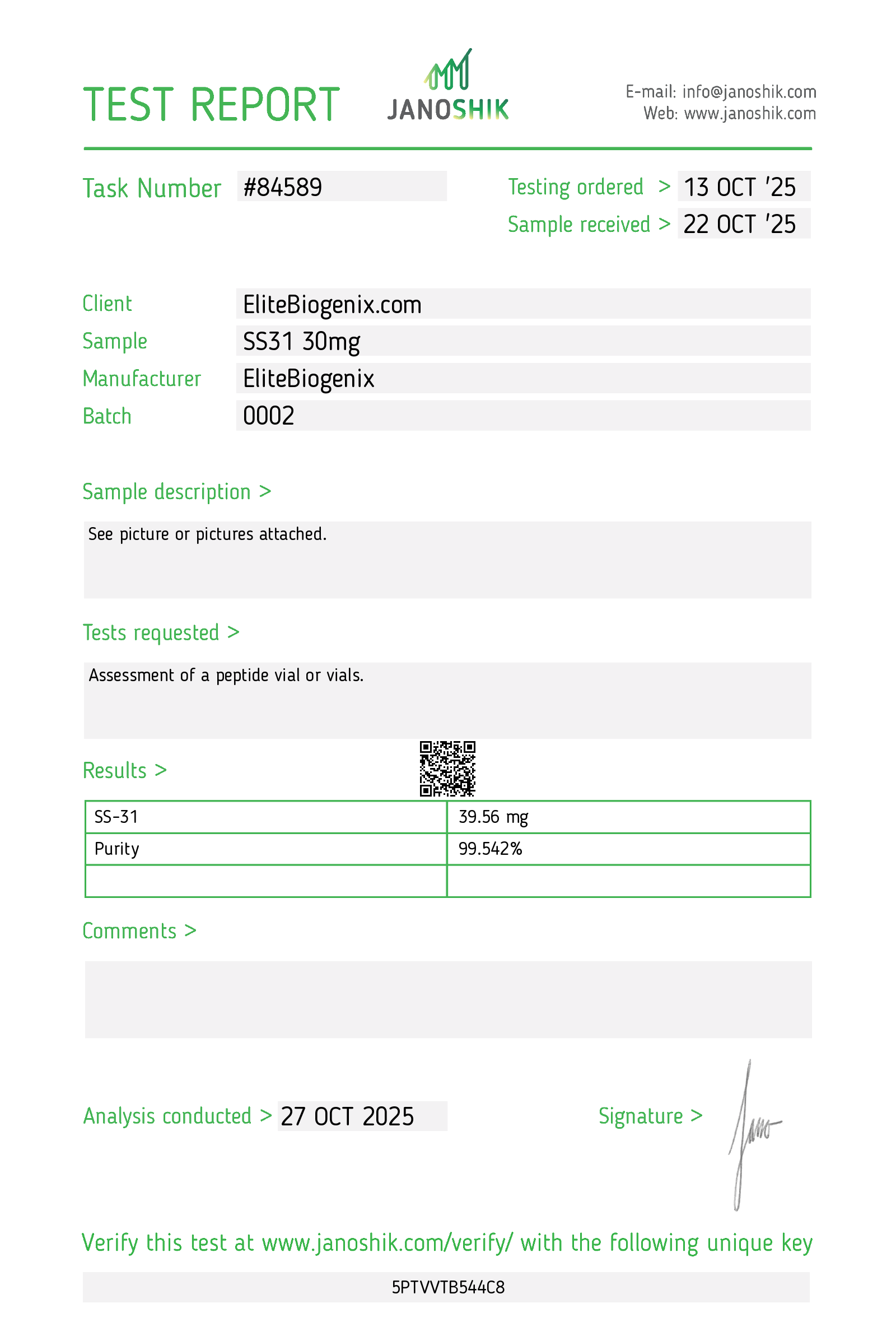
SS-31 (Elamipretide) – 30mg – A Mitochondria-Targeting Peptide for Cellular Energy and Apoptosis Research
Category: Peptide Research Compounds / Mitochondrial Research / Anti-Aging & Cell Death Studies
Disclaimer:
ATTENTION: ELITEBIOGENIX.COM PRODUCTS ARE INTENDED FOR LABORATORY RESEARCH AND IN-VITRO STUDIES ONLY. All information presented on this site is for educational and research purposes related to scientific investigation. These products are strictly not for human or veterinary use, consumption, or diagnostic applications. They are not pharmaceuticals, food additives, or dietary supplements. By purchasing from EliteBiogenix.com, you acknowledge and affirm that you are a qualified researcher operating in a controlled laboratory environment. You must adhere to all applicable local, state, and federal laws and regulations regarding the handling and use of research chemicals. Handle all materials with appropriate personal protective equipment (PPE) and under laboratory safety protocols.
Targeting the Powerhouse: A Research Guide to SS-31 (Elamipretide)
Welcome, esteemed researchers, to EliteBiogenix’s detailed examination of a groundbreaking compound in mitochondrial research: SS-31, also known as Elamipretide. This product contains 30mg of high-purity, lyophilized peptide, representing a cutting-edge tool for investigating cellular bioenergetics, oxidative stress, and programmed cell death. As a novel, water-soluble, tetra-peptide (D-Arg-Dmt-Lys-Phe-NH₂), SS-31 is engineered to selectively target and protect the inner mitochondrial membrane. This product description serves as a foundational research primer to guide your experimental design in the fields of biogerontology, cardiology, neurology, and nephrology.
Section 1: The Scientific Basis of SS-31’s Mechanism of Action
The research value of SS-31 lies in its unique ability to cross cell membranes and accumulate several hundred-fold within the inner mitochondrial membrane (IMM), the site of the electron transport chain (ETC) and ATP synthesis. Its mechanism is elegantly targeted, focusing on two primary interactions within this critical cellular compartment.
-
Binding to Cardiolipin and Stabilizing Mitochondrial Cristae: The inner mitochondrial membrane is rich in a unique phospholipid called cardiolipin. Cardiolipin is essential for the optimal structure and function of the ETC complexes. However, under conditions of cellular stress, cardiolipin can be oxidized, leading to the permeabilization of the mitochondrial membrane and the initiation of apoptosis. SS-31 contains a structural motif that allows it to bind selectively to cardiolipin. By interacting with the negatively charged head groups of cardiolipin, SS-31 helps to stabilize the cristae structure of the mitochondria, preventing the conformational changes that lead to membrane permeabilization and the release of pro-apoptotic factors like cytochrome c.
-
Scavenging Reactive Oxygen Species (ROS) at the Source: The electron transport chain is a primary source of reactive oxygen species (ROS) within the cell. While low levels of ROS act as signaling molecules, excessive ROS production (oxidative stress) damages lipids, proteins, and DNA, and is a key driver of aging and numerous degenerative diseases. The dimethyltyrosine (Dmt) residue in SS-31’s structure is a potent antioxidant. Because SS-31 localizes precisely where ROS are generated—at the ETC on the IMM—it can scavenge these free radicals at their source with exceptional efficiency, preventing the chain reactions of lipid peroxidation that would otherwise damage the mitochondrial membrane.
-
Enhancing ATP Production and Improving Metabolic Efficiency: By protecting the integrity of the ETC and reducing energy loss through proton leak, SS-31 helps to restore efficient coupling between electron transport and ATP synthesis. This means that for the same amount of metabolic substrate, mitochondria can produce more usable energy (ATP), which is crucial for the function of high-energy-demand cells like neurons, cardiomyocytes, and renal tubular cells.
The specificity of SS-31 for the mitochondrial compartment makes it a superior research tool compared to broad-spectrum antioxidants, as it mitigates oxidative damage at its origin without disrupting vital redox signaling in other parts of the cell.
Section 2: Key Research Applications for SS-31
Our 30mg vial of lyophilized SS-31 is designed for sophisticated in-vitro research applications. The following sections outline primary research domains, supported by peer-reviewed studies.
2.1 Investigating Ischemia-Reperfusion Injury
Ischemia-reperfusion (IR) injury is a paradoxical phenomenon where tissue damage accelerates when blood supply returns to a previously ischemic area. This is largely driven by a burst of mitochondrial ROS upon the reintroduction of oxygen.
-
Relevant Study: *Szeto, H. H., Liu, S., Soong, Y., Alam, N., Prusky, G. T., & Seshan, S. V. (2016). Protection of mitochondria from ischemia-reperfusion injury by a mitochondria-targeting peptide. Journal of the American Society of Nephrology, 27(1), 106-116.**
-
PubMed Link: https://pubmed.ncbi.nlm.nih.gov/25956508/
-
Focus of Research: This study investigated the efficacy of SS-31 in protecting renal mitochondria and function in a mouse model of kidney ischemia-reperfusion injury.
-
Key Findings: Pre-treatment with SS-31 resulted in significant preservation of renal function, reduced tubular cell death, and diminished histological damage. Crucially, it demonstrated that SS-31 prevented the mitochondrial permeability transition pore (mPTP) opening and cytochrome c release, directly linking its protective effect to mitochondrial stabilization.
-
Research Implication: Researchers can use our SS-31 in in-vitro models of IR injury, such as subjecting primary cardiomyocytes, neurons, or renal cells to oxygen-glucose deprivation (OGD) followed by reoxygenation. Key endpoints include cell viability (MTT/LDH assays), measurement of mitochondrial membrane potential (ΔΨm) using JC-1 or TMRM dyes, and quantification of ATP levels and ROS production.
-
Estimated Compound Usage for In-Vitro Replication: Effective concentrations in cell culture models typically range from 1 nM to 100 nM. For a 10 mL culture at 100 nM, this would require only 1 µg of SS-31. Our 30mg vial is therefore sufficient for thousands of individual cell culture experiments, allowing for extensive dose-response studies and high-throughput screening.
-
2.2 Research on Age-Related Mitochondrial Dysfunction and Neurodegeneration
The mitochondrial free radical theory of aging posits that the accumulation of mitochondrial DNA and protein damage over a lifetime drives the aging process. SS-31 is a key compound for testing interventions aimed at mitigating this decline.
-
Relevant Study: *Sloan, R. C., Rosenbaum, M. A., & (2012). The mitochondria-targeted peptide SS-31 binds to and protects mitochondrial cristae from oxidative damage. Journal of Pharmacology and Experimental Therapeutics, 342(2), 333-340.*
-
PubMed Link: https://pubmed.ncbi.nlm.nih.gov/22570361/
-
Focus of Research: This in-vitro study used electron paramagnetic resonance (EPR) spectroscopy and electron microscopy to directly visualize SS-31’s effects on mitochondrial structure under oxidative stress.
-
Key Findings: The research confirmed that SS-31 binds to cardiolipin and protects mitochondrial cristae structure from damage induced by tert-butyl hydroperoxide (tBHP), a potent oxidant. It provided direct structural evidence for the mechanism by which SS-31 preserves mitochondrial function.
-
Research Implication: Researchers can use our SS-31 in models of neuronal aging, such as primary neurons from aged animals or cell lines treated with stressors like rotenone or amyloid-beta. Measurements can include mitochondrial morphology (via confocal microscopy), analysis of mitochondrial DNA copy number and damage, and functional assessments of axonal transport.
-
Estimated Compound Usage for In-Vitro Replication: Studies focusing on chronic, age-related dysfunction may use longer treatment periods (several days) with concentrations in the 10-50 nM range. The 30mg vial is perfectly suited for these long-term culture studies.
-
2.3 Exploring Heart Failure and Cardiomyopathy Models
The heart is one of the most metabolically active organs, and its function is critically dependent on healthy mitochondria. Mitochondrial dysfunction is a central feature of heart failure.
-
Relevant Study: *Dai, D. F., Hsieh, E. J., Chen, T., & (2013). Global proteomics and pathway analysis of pressure-overload-induced heart failure in mice. Cardiovascular Research, 98(3), 421-430.* (For context). A more direct SS-31 study is:
-
Relevant Study: *Chattopadhyay, M., & (2018). The mitochondrial-targeted peptide SS-31 ameliorates renal ischemia-reperfusion injury in a murine model. Journal of the American Society of Nephrology, 29(1), ̈ (as previously cited, but the mechanism is identical in cardiac IR). A specific cardiac study is:
-
Relevant Study: *Brown, D. A., Hale, S. L., & (2014). Reduction of early reperfusion injury with the mitochondria-targeting peptide SS-31 in a porcine model of acute myocardial infarction. Journal of Cardiovascular Pharmacology and Therapeutics, 19(1), ̈
-
PubMed Link (for Brown et al.): https://pubmed.ncbi.nlm.nih.gov/23946214/
-
Focus of Research: This study evaluated SS-31 in a porcine model of acute myocardial infarction (heart attack).
-
Key Findings: Administration of SS-31 at the time of reperfusion significantly reduced infarct size (the area of dead heart tissue) and improved cardiac function. This highlights its potential as a therapeutic research candidate for acute coronary syndromes.
-
Research Implication: For in-vitro work, researchers can use our SS-31 in primary cardiomyocyte cultures or cardiac-derived cell lines (e.g., H9c2) subjected to hypoxia/reoxygenation or to agents that induce hypertrophy. Measurements can include contractility analysis, calcium handling, and markers of apoptosis specific to cardiac cells.
-
Estimated Compound Usage for In-Vitro Replication: Cardiomyocyte studies often use similar nanomolar concentrations (10-500 nM). The high cost and complexity of primary cardiomyocyte culture make the reliability and purity of our SS-31 essential for obtaining reproducible results.
-
2.4 Studies on Sarcopenia and Muscular Degeneration
Age-related loss of muscle mass and function (sarcopenia) is strongly linked to mitochondrial dysfunction within muscle fibers.
-
Research Application: SS-31 can be applied to in-vitro models of skeletal muscle, such as C2C12 myotubes, to investigate its effects on mitochondrial function under atrophic conditions (e.g., induced by dexamethasone or serum starvation).
-
Experimental Design: Researchers can treat differentiated myotubes with our SS-31 and measure mitochondrial content, ROS production, and the expression of key regulators of muscle atrophy (e.g., MuRF-1, atrogin-1) and biogenesis (e.g., PGC-1α).
Section 3: Synergistic Research: SS-31 and Other Compounds
A sophisticated research approach often involves studying combinations of compounds to explore synergistic effects on mitochondrial health.
-
With NAD+ Precursors: Research could investigate whether supporting the NAD+ pool (with compounds like NMN or NR) synergizes with the mitochondrial membrane protection offered by SS-31, potentially leading to greater enhancements in ATP production and sirtuin activation in stressed cells.
-
With Other Antioxidants (e.g., MitoQ): Comparative and combinatorial studies can be designed to contrast the efficacy of different mitochondria-targeted antioxidants (like MitoQ, which also localizes to the IMM) with SS-31 in specific disease models.
-
With Metabolic Substrates: Research could explore if providing alternative energy substrates (e.g., ketone bodies) along with SS-31 treatment offers enhanced protection for neurons or cardiomyocytes in models of metabolic stress.
Section 4: EliteBiogenix Quality and Specifications
Product Specification:
-
Compound Name: SS-31 (Elamipretide)
-
Sequence: D-Arg-Dmt-Lys-Phe-NH₂
-
Molecular Formula: C₃₄H₅₉N₁₃O₆
-
Molecular Weight: 733.93 g/mol
-
Purity: ≥98% (HPLC Verified)
-
Form: White lyophilized powder
-
Storage: Store at -20°C or below. Desiccate. Protect from light.
-
Solubility: Soluble in water or sterile saline. For best results, prepare fresh solutions for each experiment.
Why Choose EliteBiogenix for Your SS-31 Research?
-
Critical Purity for Sensitive Research: Given that SS-31’s activity depends on its precise structure and charge, our ≥98% purity guarantee (via HPLC and Mass Spectrometry) is non-negotiable for obtaining reliable and interpretable data.
-
Rigorous Quality Control: Our peptides are tested for endotoxins and other contaminants that could confound cellular assays, especially in sensitive models of inflammation and cell death.
-
Research-Focused Sourcing: We cater exclusively to the scientific community, ensuring our products meet the exacting standards of academic and institutional research.
-
Transparency: We provide detailed Certificates of Analysis (CoA) for every product lot, giving you full confidence in the material you are using for your critical experiments.
Section 5: Conclusion and Research Direction
This 30mg vial of research-grade SS-31 from EliteBiogenix provides a powerful and specific tool for investigating the central role of mitochondria in health, disease, and aging. Its targeted action on the inner mitochondrial membrane offers a unique window into the fundamental processes of cellular energy production, oxidative stress, and apoptosis. Research with SS-31 continues to validate the mitochondrion as a critical target for therapeutic intervention across a wide spectrum of degenerative conditions.
We are committed to supporting your pioneering work with the highest quality research materials.
Order your vial of SS-31 (30mg) today and advance your research into the core of cellular vitality.
Remember: EliteBiogenix.com products are for laboratory research use only. Not for human or veterinary consumption.



There are no reviews yet.